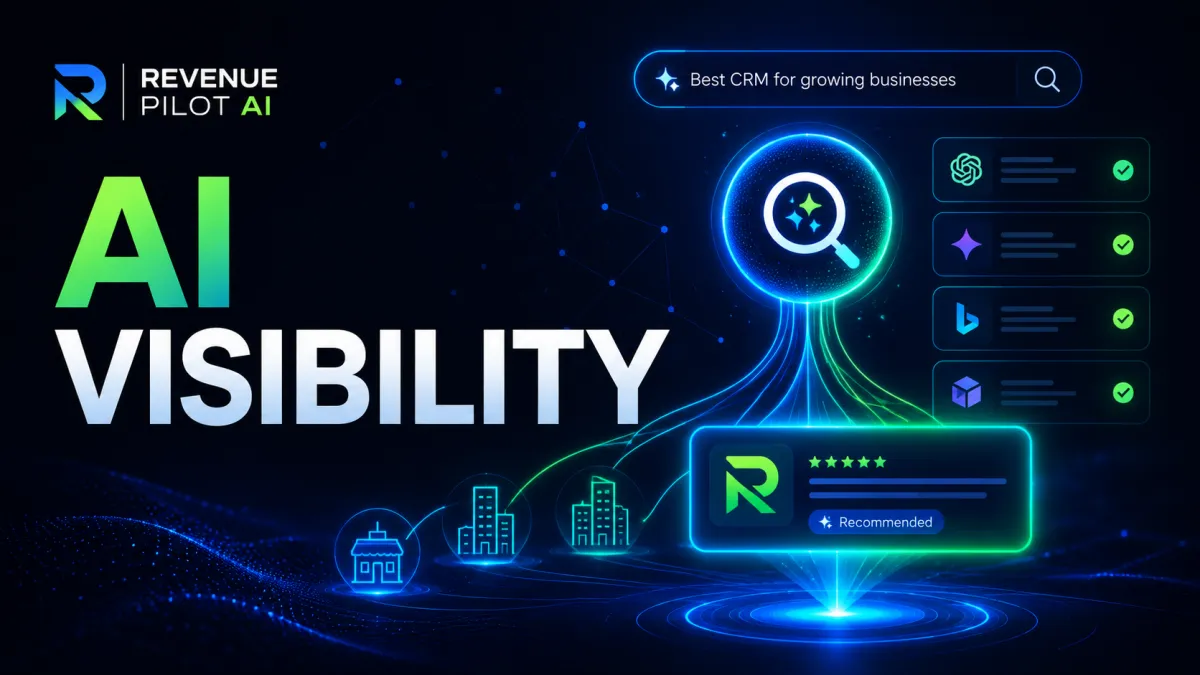
Why Contractors Are Invisible in AI Search Even When You Rank #1 on Google Maps
Why Contractors Are Invisible in AI Search Even When You Rank #1 on Google Maps
Ranking at the top of Google Maps used to feel like the finish line.
A homeowner searches for “AC repair near me,” your company appears first, and the phone rings. You have more visibility than the competitors below you, so it seems reasonable to assume your business will also dominate every other search platform.
That assumption is becoming dangerous.
A contractor can rank first in Google Maps and still be ignored when a customer asks ChatGPT, Gemini, or another AI-powered search tool which company to hire.
The business that wins in Maps is not always the business AI recommends.
That difference creates a new problem for local contractors: the AI visibility gap.
Google Maps visibility and AI visibility are not the same thing
Google Maps is designed to produce a ranked list of local businesses.
AI search is designed to produce an answer.
Those two systems may overlap, but they are solving different problems.
Google Maps is trying to decide:
Which nearby businesses are most relevant to this local search?
An AI assistant is trying to decide:
Which business can I confidently recommend, and what evidence supports that recommendation?
Your Google Business Profile may give Google enough information to rank your company. But an AI system may look beyond your profile and evaluate the broader story it can find across the web.
That can include:
Your website
Service pages
Location pages
Customer reviews
Business directories
Industry associations
Local news mentions
Chamber listings
Citations and third-party references
When those sources are incomplete, inconsistent, vague, or disconnected, AI may struggle to understand your business.
Meanwhile, a competitor with a lower Maps position may provide a clearer and more verifiable story.
That competitor may get the recommendation—and the call.
A real-world example
Imagine two HVAC companies serving the same city.
Company A
Ranks first in Google Maps
Has 89 reviews
Uses the broad category “HVAC contractor”
Has a basic five-page website
Mentions several cities on one service-area page
Has mostly generic reviews such as “Great service” and “Highly recommend”
Company B
Ranks third in Google Maps
Has 47 reviews
Has dedicated pages for AC repair, furnace replacement, heat-pump service, emergency HVAC repair, and maintenance
Has separate location pages for the cities it serves
Has reviews that mention the service performed, the city, the response time, and the outcome
Appears in local directories, trade associations, and community sources
Company A may win the traditional Maps ranking.
Company B may be easier for AI to understand.
When someone asks:
“Which HVAC company in Arnold, Missouri, would you recommend for emergency AC repair?”
Company B may give the AI system more specific evidence to support an answer.
That is how a contractor can be highly visible in Maps but practically invisible inside AI search.
The five signals AI needs to understand your business
There is no single switch that controls AI visibility. The problem is usually caused by several weak or disconnected signals.
Here are the five areas contractors should examine first.
1. Service clarity
Many contractor websites describe the business too broadly.
A homepage may say:
“We provide quality HVAC services for residential and commercial customers.”
That sounds fine to a person, but it provides very little detail.
What kind of HVAC work?
Emergency AC repair?
Furnace replacement?
Heat-pump installation?
Mini-split service?
Commercial refrigeration?
Indoor-air-quality testing?
Preventive maintenance?
AI systems need enough information to associate your company with the exact service a customer requests.
A business that only describes itself as an “HVAC contractor” may be less understandable than a competitor with detailed pages explaining each service.
What to fix
Create focused pages for the services you want to sell.
Each important service page should explain:
What the service includes
Common customer problems
When the service is needed
The types of systems you work on
The locations where the service is available
Why customers should trust your company
What the customer should do next
Do not create dozens of thin pages with nearly identical text. Build useful pages that genuinely answer customer questions.
2. Location confidence
A service-area business may claim to serve an entire metro area, but AI still needs evidence connecting the company to specific locations.
Simply listing 40 cities in the footer does not prove that your business actively serves those communities.
Stronger location evidence may come from:
Detailed city pages
Reviews mentioning the city
Projects completed in the area
Local directory listings
Local sponsorships
Chamber memberships
Consistent service-area information
Website content tied to actual local work
For example, a roofing contractor may say it serves St. Louis County. But a competitor may have useful pages describing storm-damage repair in Arnold, roof replacement in Fenton, and emergency tarping in Kirkwood.
The competitor gives AI more local context.
What to fix
Start with the cities that produce the most valuable jobs.
Build location pages that explain:
The services offered in that city
Common local problems
Recent types of work performed
Nearby neighborhoods or service zones
Customer experiences from that area
How quickly your team can respond
The goal is not to repeat the same page with a different city name. The goal is to establish legitimate local relevance.
3. Reputation context
Review count matters, but the content of the reviews also matters.
A five-star review that says “Great job” offers very little context.
A review that says:
“The technician arrived the same afternoon, diagnosed our failed AC capacitor, and had the system running again before dinner”
provides much more useful information.
It tells a reader—and potentially an AI system:
What service was performed
What problem existed
How quickly the company responded
What result the customer received
A competitor with fewer but more descriptive reviews may be easier to recommend than a company with a larger collection of vague reviews.
What to fix
Never write or script reviews for customers.
Instead, ask customers to honestly describe their experience.
A review request can encourage them to mention:
The service they received
The problem they were experiencing
Their location
The response time
The technician or team member
The outcome
Specific, natural reviews help customers understand your company and create a clearer reputation story across the web.
4. Third-party confirmation
Your own website will naturally say your company is experienced, reliable, and trustworthy.
AI search may place additional value on sources that confirm those claims independently.
Examples include:
Better Business Bureau profiles
Chamber of Commerce listings
Trade-association memberships
Manufacturer dealer pages
Local business directories
Community sponsorships
Local news coverage
Supplier or partner pages
Industry award listings
These outside references help establish that the business exists, operates where it claims, and is recognized by other organizations.
A contractor with a strong Google Business Profile but almost no footprint outside Google may be harder to verify than a competitor with multiple credible third-party mentions.
What to fix
Audit where your business appears outside your own website.
Make sure those listings use consistent information:
Business name
Address
Phone number
Website
Services
Service area
Business description
Then look for legitimate opportunities to strengthen your local and industry presence.
Do not buy hundreds of low-quality directory links. Focus on credible sources tied to your market, trade, or community.
5. Consistency across sources
A business may have all the right information, but still create confusion when different sources tell different stories.
For example:
The Google Business Profile says “HVAC contractor”
The website focuses mainly on plumbing
One directory lists a previous phone number
A service page says the company serves St. Louis
Another page says it only serves Jefferson County
Social profiles use an old business name
Review sites link to an outdated domain
A person may be able to recognize that these records belong to the same company.
An AI system may not be as confident.
Conflicting information can weaken the overall business story.
What to fix
Compare your most important online sources and verify that they agree on:
What your company does
Where it operates
How customers contact you
Which business name you use
Which website represents the company
Which services are most important
Consistency does not mean every page must contain identical wording. It means the facts should not contradict one another.
The five-minute AI visibility check
You can test your current visibility without buying software.
Choose one of your highest-value services and one target city.
For example:
Emergency AC repair in Arnold, Missouri
Then run the same basic search across multiple platforms.
Step 1: Search Google
Search the service and city.
Record:
Which businesses appear in the Map Pack
Where your company ranks
Which competitors appear above or below you
Step 2: Ask ChatGPT
Use a specific prompt such as:
“Which AC repair company in Arnold, Missouri, would you recommend? Use current web sources and explain the recommendation.”
Record:
Which company is recommended
How the company is described
Which sources support the answer
Whether your business appears at all
Step 3: Ask Gemini
Run the same query in Gemini.
Record the same information.
Step 4: Compare the winners
You may discover three different outcomes:
One business wins Google Maps
Another is recommended by ChatGPT
A third appears in Gemini
That comparison exposes the visibility gap.
Step 5: Inspect the sources
Look closely at the sources supporting the AI recommendation.
They may reveal that the competitor has:
Better service pages
Stronger city relevance
More descriptive reviews
More consistent business information
Better third-party confirmation
A clearer explanation of what the company does
Those sources give you a practical roadmap for what to improve.
What contractors often get wrong
The biggest mistake is treating AI visibility as another keyword-ranking project.
It is not enough to insert “HVAC contractor near me” into a few pages.
AI search needs a business it can understand, verify, and explain.
That means your online presence must answer three questions clearly:
What does this contractor actually do?
Where does this contractor perform the work?
Why should this contractor be trusted?
Your Google Business Profile, website, reviews, location signals, and outside mentions should all support the same answers.
When they do, your business becomes easier for both customers and AI systems to understand.
What to fix first
Do not try to repair everything at once.
Start with the highest-impact gaps.
First: clarify your core services
Make sure your website has useful pages for the jobs you most want to sell.
Second: strengthen your priority locations
Build credible evidence connecting those services to the cities you actually serve.
Third: improve review context
Ask customers to describe their real experience in their own words.
Fourth: correct inconsistent business information
Fix outdated listings, old phone numbers, conflicting service areas, and duplicate business records.
Fifth: build credible outside confirmation
Strengthen your presence in legitimate local, trade, and community sources.
Ranking first is no longer enough
Google Maps remains one of the most valuable sources of local leads.
But customer behavior is changing.
People are increasingly asking AI tools to compare businesses, explain their options, and recommend who to hire.
That means contractors now have to win in two environments:
Traditional local search
AI-generated recommendations
You can rank first in Maps and still lose the customer before they ever see your listing.
The contractor who wins the next phase of local search will not simply be the one with the highest Maps position.
It will be the business that is easiest to find, understand, verify, and recommend.
Find your AI visibility gap
Revenue Pilot AI’s free AI Visibility Audit examines whether ChatGPT, Gemini, and other search experiences can clearly understand and recommend your business.
The audit reviews the signals connecting your:
Google Business Profile
Website
Services
Locations
Reviews
Third-party sources
Get your free audit here:


