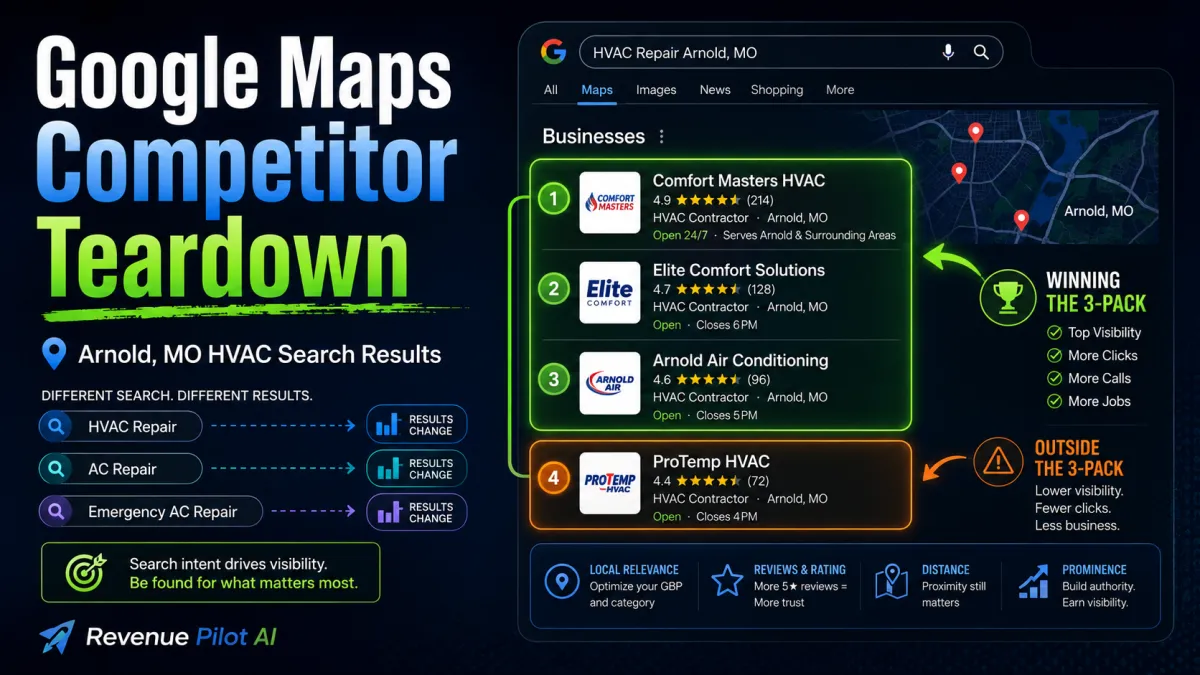
Why the #1 HVAC Company Disappears When You Add One Word to the Search
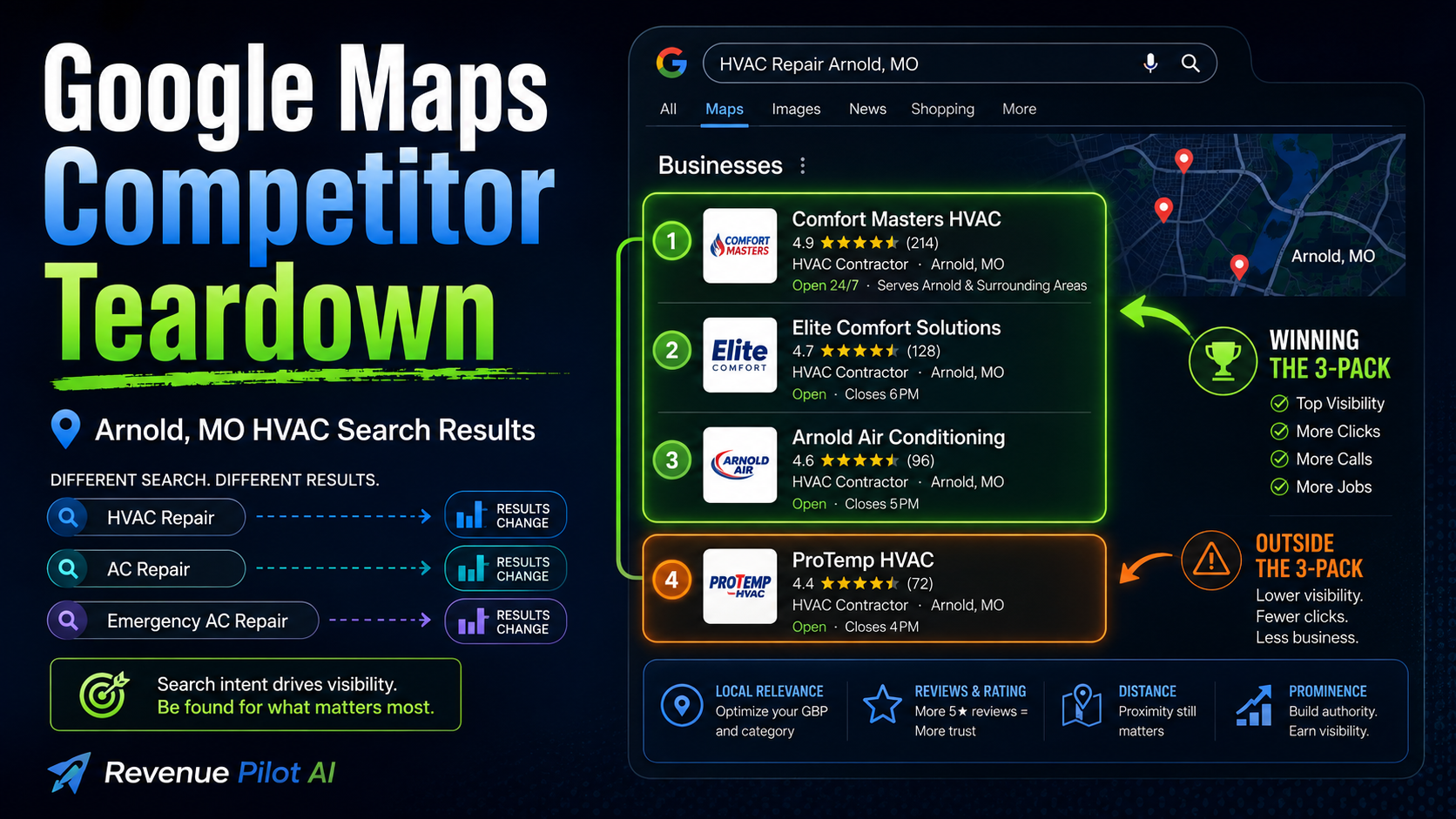
A contractor can be ranked at the top of Google Maps and still lose some of the most valuable calls in the market.
That sounds contradictory until you stop thinking about Google Maps as a single ranking.
During a recent HVAC competitor teardown in Arnold, Missouri, I searched:
“HVAC repair Arnold MO.”
Busch Heating & Cooling was sitting at #1.
Then I searched:
“AC repair Arnold MO.”
Busch was again #1.
Then I changed the search to:
“emergency AC repair Arnold MO.”
Busch was no longer in the Google Maps 3-Pack.
Three competitors were now getting the most visible positions.
Same company. Same market. Same general service category.
One change in search intent—and a completely different competitive result.
For a contractor, that is not just an SEO curiosity.
It can mean lost phone calls, lost service jobs, and revenue going to competitors before the customer ever sees your business.
You Don't Have One Google Maps Ranking
This is one of the biggest mistakes local service businesses make when evaluating their Google Business Profile.
They ask:
“Where do I rank?”
But the better question is:
“Where do I rank for each search customers use when they are ready to hire?”
Those are very different questions.
An HVAC company might perform extremely well for:
·HVAC repair
·AC repair
·heating and cooling
·HVAC contractor
…and still underperform for:
·emergency AC repair
·furnace repair
·AC replacement
·same-day HVAC repair
·24-hour HVAC service
If those searches represent customers with urgent problems and high buying intent, the ranking gap can be far more important than a #1 position for a broader phrase.
The business owner does not get paid for ranking reports.
The business owner gets paid when visibility turns into a call, the call turns into a booked job, and the job turns into revenue.
The Review Count Surprise
The emergency AC search exposed something else worth paying attention to.
Busch had more than 340 reviews.
One of the businesses appearing in the 3-Pack, Five Star Heating and Cooling, had only 28.
That immediately challenges one of the assumptions I hear constantly:
“I just need more reviews.”
Reviews matter. Reputation matters. Customers absolutely use them when deciding whom to call.
But raw review count does not automatically guarantee that you will outrank a smaller competitor for every search.
A business with fewer reviews can still become more visible for a particular search if its overall online presence is better aligned with what that customer is looking for.
That should actually be encouraging to smaller contractors.
You may not need to catch a competitor with hundreds or thousands of reviews before you can begin competing for valuable service searches.
And for established contractors, it is a warning.
A large review advantage does not mean every high-intent search is protected.
What the Competitors Were Doing Differently
Once the emergency search changed the 3-Pack, I looked deeper.
The goal was not to find one “magic ranking factor.”
It was to look for patterns across the businesses Google was choosing to display.
Five Star Heating and Cooling
Five Star had dramatically fewer reviews than Busch, but its profile and customer feedback contained strong service-specific signals.
Its Google Business Profile visibly included services such as AC repair and emergency heating and air repair.
Its reviews also included language around:
·same-day help
·emergency situations
·overnight service
·Saturday calls
·urgent cooling problems
That matters because the business is repeatedly presenting evidence that it handles the exact kind of problem behind an emergency HVAC search.
The important lesson is not to stuff keywords into reviews.
Never tell customers exactly what to write.
The opportunity is to consistently perform the service you want more of and make it easy for customers to leave honest feedback about what happened.
If someone called you at 9 p.m. because the AC stopped working and you had them cooling again that night, that is naturally the kind of experience they may describe.
That real customer language becomes powerful proof for the next homeowner with the same problem.
Classic Aire Care Reinforced Emergency Intent
Classic Aire Care showed a similar pattern on a much larger scale.
Its web presence included strong AC repair and emergency-service messaging, along with a substantial review base.
The important point is the consistency.
A homeowner searching for emergency AC repair can see multiple signals telling the same story:
“This company handles urgent cooling problems.”
That message is not confined to one sentence.
It is reinforced across the website, reviews, service information, and business presence.
That consistency helps both search engines and customers understand exactly what the company does.
And from a business perspective, clarity reduces friction.
The faster a customer thinks, “Yes, these guys handle my exact problem,” the faster they can move toward making the call.
Mechanical Climate Solutions Made Emergency Service Obvious
Mechanical Climate Solutions also reinforced urgent service very clearly.
Its website promoted 24-hour emergency service, and it had dedicated residential AC repair content.
Its reviews included situations involving extreme heat, early-morning calls, urgent service, and rapid response.
Again, none of these things alone prove why a company holds a particular Maps position.
Local rankings can vary by location, time, device, personalization, and other factors.
But when multiple competitors appearing for the same high-intent search consistently reinforce the same service intent, that pattern deserves attention.
Busch Wasn't Doing Anything “Bad”
This is important.
Busch had a strong reputation.
It ranked #1 for broader HVAC and AC repair searches.
Its website did mention 24/7 emergency service.
This was not an example of a bad company with a broken Google profile.
That is exactly what makes the case useful.
A business can be doing many things right and still have a specific visibility gap.
In the material I reviewed, Busch's deeper cooling content appeared to lean more heavily toward general cooling and installation messaging than a dedicated emergency AC repair experience.
That creates an opportunity.
Not necessarily a full rebuild.
Not hundreds more reviews.
Not automatically more ad spend.
A targeted gap.
And targeted gaps can often be attacked much more efficiently.
Rankings Should Be Treated Like Revenue Channels
Imagine an HVAC owner looks at one ranking report and sees:
AC repair — #1
He assumes Google Maps is handled.
Meanwhile, competitors are showing above him for:
Emergency AC repair
A homeowner whose air conditioner has stopped working in 95-degree weather is not casually researching HVAC companies.
That customer may be ready to call immediately.
If your company is absent from the most visible results at that moment, you may never know the opportunity existed.
There is no missed-call notification.
There is no lost-lead record in your CRM.
The customer simply calls someone else.
That is why these visibility gaps are so dangerous.
They create invisible lost revenue.
The Revenue Math Is What Actually Matters
Suppose a visibility gap causes a contractor to miss just 10 qualified calls in a month.
If the company normally closes 60% of those opportunities, that is six jobs.
If the average job is worth $650, that is:
6 × $650 = $3,900 in potential monthly revenue.
Annualized:
$46,800.
And that still does not account for:
·future maintenance agreements
·repeat service
·referrals
·future equipment replacements
·additional work from the same household
That is why I do not like treating Google Maps optimization as a vanity-ranking exercise.
The ranking itself is not the outcome.
The real chain is:
Search visibility → phone call → booked appointment → completed job → revenue.
Every weakness in that chain deserves to be measured in business terms.
Five Things I Would Fix First
If I were addressing the gap uncovered in this teardown, these would be the priorities:
·Build or strengthen a dedicated emergency AC repair page. Make the service, location, availability, urgency, and next action immediately clear.
·Align Google Business Profile services with the work you want to win. If emergency AC repair is an important revenue service, the profile should clearly reflect it.
·Generate natural review context from real emergency jobs. Ask customers for honest feedback after the service rather than scripting what they should say.
·Publish fresh job-site proof. Show real technicians, equipment, service calls, and work being performed in the target market.
·Track high-intent searches individually. Do not let one strong keyword hide weaknesses in another.
That last one may be the most important.
Stop Tracking Rankings. Start Tracking Money Keywords.
A contractor should know how visible the business is for the searches most closely connected to revenue.
For an HVAC company, that could include:
HVAC repair. AC repair. Emergency AC repair. Furnace repair. Furnace replacement. AC replacement. Heat pump repair. 24-hour HVAC service.
The exact list depends on the services, margins, market, and type of customer the company wants.
But each important service should be evaluated independently.
Because every time the customer changes the search, you may be competing against a different group of businesses.
The Bigger Opportunity for Contractors
This teardown is not really about Busch Heating & Cooling.
It is about what the example reveals for every local service company.
You can have:
·A strong reputation.
·Hundreds of reviews.
·A good website.
·A well-established company.
And still have high-value searches where competitors are capturing the visibility—and potentially the calls—you thought you already owned.
The opportunity is to identify those gaps before simply throwing more money at advertising.
If Google is already receiving searches from people looking for exactly what you sell, improving your ability to capture that existing demand can be extremely valuable.
You are not trying to manufacture demand.
You are trying to stop qualified customers from choosing a competitor before they ever discover you.
Find the Searches That May Be Costing You Jobs
If you own an HVAC, plumbing, roofing, electrical, or other local service business, do not settle for knowing that you “rank well on Google.”
Find out which searches you win, which searches your competitors win, and which gaps may be costing you calls and booked jobs.
Revenue Pilot AI's GBP Visibility Audit is designed to uncover those opportunities.
Get the GBP Visibility Audit:
https://morelocalleadsnow.com/gmb-visibility-fix
Because ranking #1 feels good.
Turning search visibility into more calls, more booked jobs, and more revenue is what actually matters.
Google Maps results vary based on search location, time, device, personalization, and other factors. The Arnold, Missouri example above reflects observed search results and publicly visible business information. The analysis identifies patterns and opportunities; it does not claim that any single factor caused a specific Google Maps position.


